News About Contact (281) 499-0561
Material Fabrication

Granite, fabricated to outlast the building around it.

When a countertop has to survive commercial-grade daily use — knives, heat, foot traffic, decades of service — granite is still the benchmark. We fabricate it in-house, in volume, to spec, for kitchens and job sites across Houston.

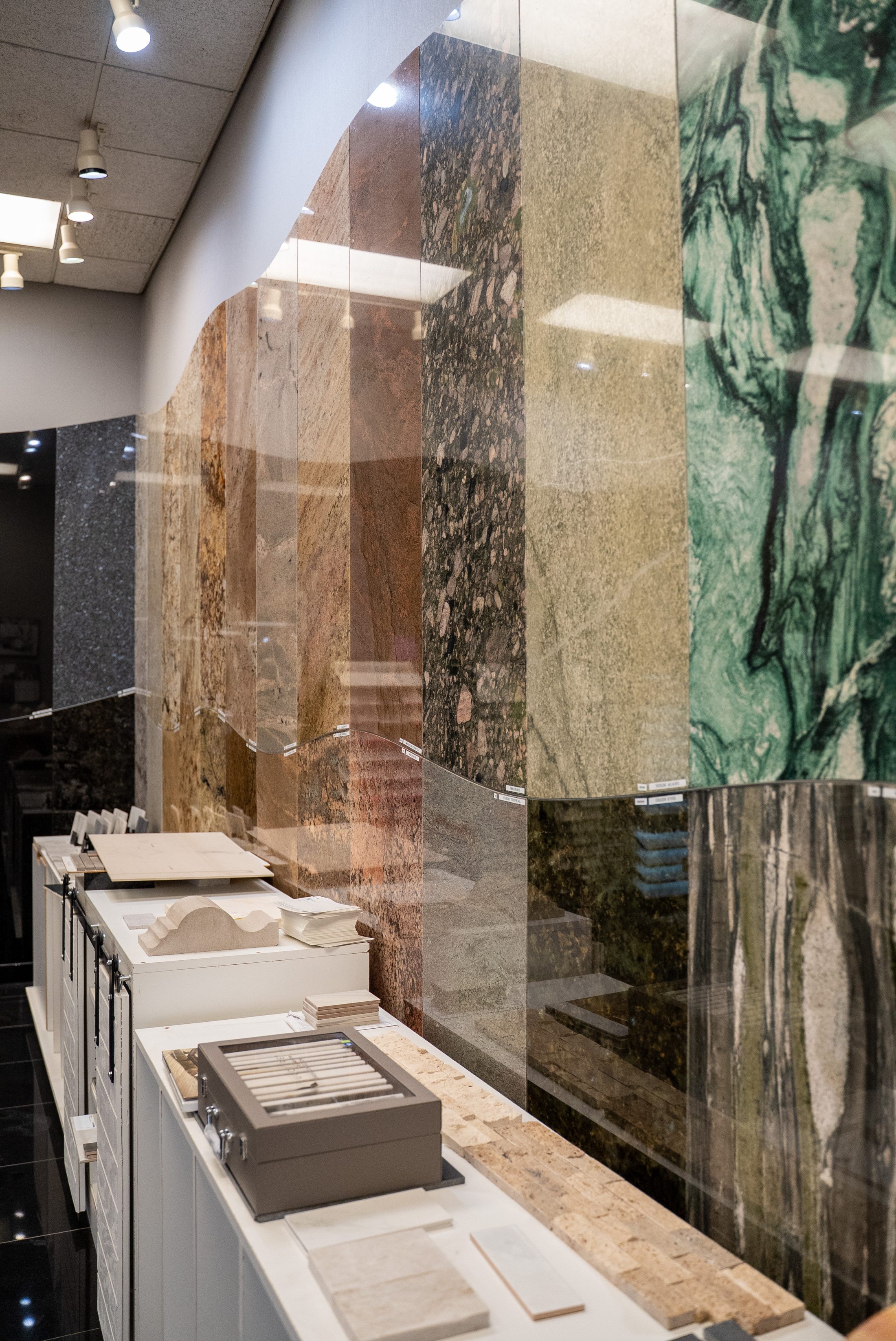
Granite and natural stone slabs selected at Cangelosi Company's Missouri City showroom

Granite is igneous rock — cooled and compressed under enough heat and pressure that its interlocking quartz, feldspar, and mica crystals form one of the densest natural stones available for fabrication. That density is the whole story: at roughly a 6 to 7 on the Mohs hardness scale, granite resists scratching from daily kitchen use, shrugs off a hot pan set straight from the stove, and holds up to the kind of abuse a break room counter or a hospital nurses' station sees every single shift. It's also far more resistant to etching from acidic contact than marble, which is why it's stayed the default recommendation for busy kitchens for decades.

For commercial work specifically, granite's consistency matters as much as its durability. Because it's quarried in large blocks, we can fabricate long, continuous countertop runs — a multi-unit break room, a hotel corridor of vanities, a bank of reception desks — from slabs cut close together in the same lot, so color and pattern stay consistent unit to unit instead of looking like a mismatched patchwork. That same high-yield slab nesting is what lets us cut material waste and hold commercial material cost roughly 30% below competitors on large runs, without switching to a cheaper stone.

Granite isn't zero-maintenance — a quality sealer applied at install still extends the life of a polished finish, and we tell every client what schedule actually fits their stone and their use, rather than a one-size-fits-all answer. But compared to softer natural stones, it asks for far less attention over the life of the surface, which is exactly why it's the right call for spaces that can't afford to baby a countertop: commercial kitchens, food-service prep lines, high-traffic office pantries, and any residential kitchen that sees real daily use rather than the occasional weekend meal.

We template, cut, edge, and polish or hone granite in-house at our 52,080 sq ft Missouri City shop, then install it with our own crews — the same fabrication-to-install pipeline whether the job is a single kitchen or a multi-building commercial package. Whatever the finish schedule calls for, it comes off the same floor we've run since 1970.

Common Applications

Where granite is the right call.

Commercial counters and prep lines. Break rooms, nurses' stations, teller lines, food-service prep counters — anywhere staff are working the same surface all day, every day. Granite's hardness handles knife contact, hot pans, and constant wipe-downs without the surface degrading the way a softer stone would over a multi-year commercial lease.

High-traffic surfaces generally. Reception desks, lobby counters, and common-area surfaces in office, healthcare, hospitality, and multi-family builds all lean on granite for the same reason: it's the natural stone that tolerates the heaviest daily contact without babying. When a GC needs one material spec across dozens of units or a full building's common areas, granite's consistency and durability both do real work.

Exteriors. Granite's density and low porosity make it one of the few natural stones that holds up outdoors in Houston's heat, humidity, and freeze-thaw swings without the sealing schedule a softer stone would need. We fabricate granite for exterior sills, outdoor kitchen surfaces, and masonry accents where the stone is exposed to weather year-round, not just tucked inside a climate-controlled building.

Residential kitchens with real daily use. Plenty of homeowners still choose granite over quartz for a kitchen that sees actual cooking — hot pots straight from the stove, knife work directly on the surface, kids and daily wear — because it doesn't require the same babying a softer surface would.

Care & Maintenance

Lower-maintenance than marble — and that contrast matters.

The clearest way to explain granite's maintenance profile is by comparison: where marble etches from acidic contact and needs a maintenance conversation before it ships, granite shrugs off the same citrus, wine, and vinegar-based contact that would dull a marble finish. That single difference is why granite, not marble, is still the default recommendation for kitchens and any surface seeing daily acidic exposure.

Granite still isn't zero-maintenance. We apply a quality sealer at install, and depending on the specific granite's porosity — which does vary slab to slab — we'll recommend a re-sealing interval anywhere from every few years to well beyond that for the densest, least-porous stones. Day to day, granite cleans with plain soap and water or a stone-safe cleaner; it doesn't require the specialty pH-neutral products or the etching vigilance marble does.

The practical upshot for a facilities manager or GC managing a commercial building: granite countertops go on the maintenance schedule and largely stay off the maintenance headache list. That's a meaningfully different conversation than the one we have with clients spec'ing marble, and it's a large part of why granite remains the volume material for commercial fabrication.

Commercial Fabrication

Why granite is our default recommendation for high-volume commercial work.

When a GC or property owner is speccing dozens or hundreds of linear feet across a building — not one kitchen, but every unit in a multi-family development or every counter in an office common area — three things matter more than they do on a single residential job: durability that doesn't vary by unit, consistent appearance across every slab, and a cost structure that scales without surprises. Granite delivers on all three in a way that's hard to match.

Durability we've covered — granite simply tolerates commercial daily use better than softer stones. Consistency comes from how we buy and cut it: quarrying granite in large blocks means we can pull slabs from the same lot for an entire commercial order, so unit 4's countertop reads the same as unit 40's instead of drifting in color or pattern partway through a build. And because that same slab-nesting approach lets us cut material waste on large runs, we can hold commercial material cost roughly 30% below competitors without dropping down to a lower-grade stone to hit a number.

That combination — a stone built for volume durability, sourced for batch consistency, and fabricated at a cost that scales with the job — is why granite is the material we reach for first when a GC asks "what should we spec for the whole building," and why it's stayed the commercial default even as engineered alternatives have entered the market.

Common Questions

Granite fabrication, answered.

How heat- and scratch-resistant is granite, specifically?

Granite sits around a 6 to 7 on the Mohs hardness scale, dense enough that a hot pan straight off the stove or a knife blade run directly on the surface won't damage it under normal use — well above marble's roughly 3 to 4 rating. We still recommend a cutting board for edge longevity and to protect the knife, not the counter, but granite tolerates far more daily abuse without babying than any softer natural stone.

Does granite need to be sealed?

Yes, but far less urgently than marble. We apply a sealer at install, and depending on the specific stone's porosity we typically recommend re-sealing every few years — some dense granites go well beyond that. Day-to-day cleaning is simple soap and water; it doesn't require the acid-avoidance vigilance marble does.

Can you keep color and pattern consistent across a large commercial order?

Yes — because granite is quarried in large blocks, we source slabs from the same lot for a full commercial run whenever order size allows, so a 40-unit job doesn't drift in color partway through. For large orders we recommend locking in material early, since we're pulling from a finite lot rather than an unlimited engineered supply.

Granite or quartz for a commercial kitchen?

Both work; the choice usually comes down to use case and budget. Granite is the traditional pick for heavy daily use and holds up to heat and knife contact exceptionally well. Quartz is engineered, non-porous, and doesn't need sealing at all, with near-perfect batch consistency — which is why we often steer very high-volume commercial kitchens toward quartz specifically for its zero-sealing maintenance profile. We'll lay out the real trade-offs for your specific kitchen rather than push one material by default.

What's the typical lead time for a granite job?

Granite generally moves faster than marble since matched-slab sourcing is less of a bottleneck and it's the material we fabricate in the highest volume. Exact timing depends on order size and finish schedule — we give a firm lead time once we know scope, and for large commercial runs we build slab sourcing into that schedule up front so it doesn't become a surprise mid-project.

Used across:

Commercial Luxury Residential Kitchen & Bath
Ready When You Are

Send us the spec — we'll quote the granite.