Every stone that leaves our shop crosses the same three systems: 4-axis CNC waterjet cutting, Sawjet processing, and SlabSmith digital nesting software. Together they're the reason our material yield — and your invoice — beats a standard fabricator.
High-yield digital nesting means more finished stone comes out of every slab we cut — so the material line on your job costs less than it does through a fabricator still laying out slabs by eye. It isn't a sale price. It's how the stone is cut, on every job, every time.
Manual layout has a waste habit built into it. Templates get squared up conservatively, seams get placed to avoid risk rather than to save stone, and once a slab shows real veining movement or a natural fissure, a chalk-and-eyeball layout tends to write off more of the slab than the flaw actually costs. Digital nesting removes that guesswork — the software works from the same slab a fabricator would look at, but it tests far more placements than a person has time to check by hand, and it does it before a single ounce of stone is cut.
These aren't three separate services — they're one workflow. Nesting software plans the cut before a blade ever moves, and the waterjet and sawjet floor executes it to the layout you've already approved. A waterjet is only as efficient as the layout it's cutting from — feed it a tightly nested file and the machine's precision translates directly into yield; feed the same machine a rough manual layout and you get precisely cut parts arranged wastefully. The software is what makes the hardware's accuracy actually pay off on your material line.
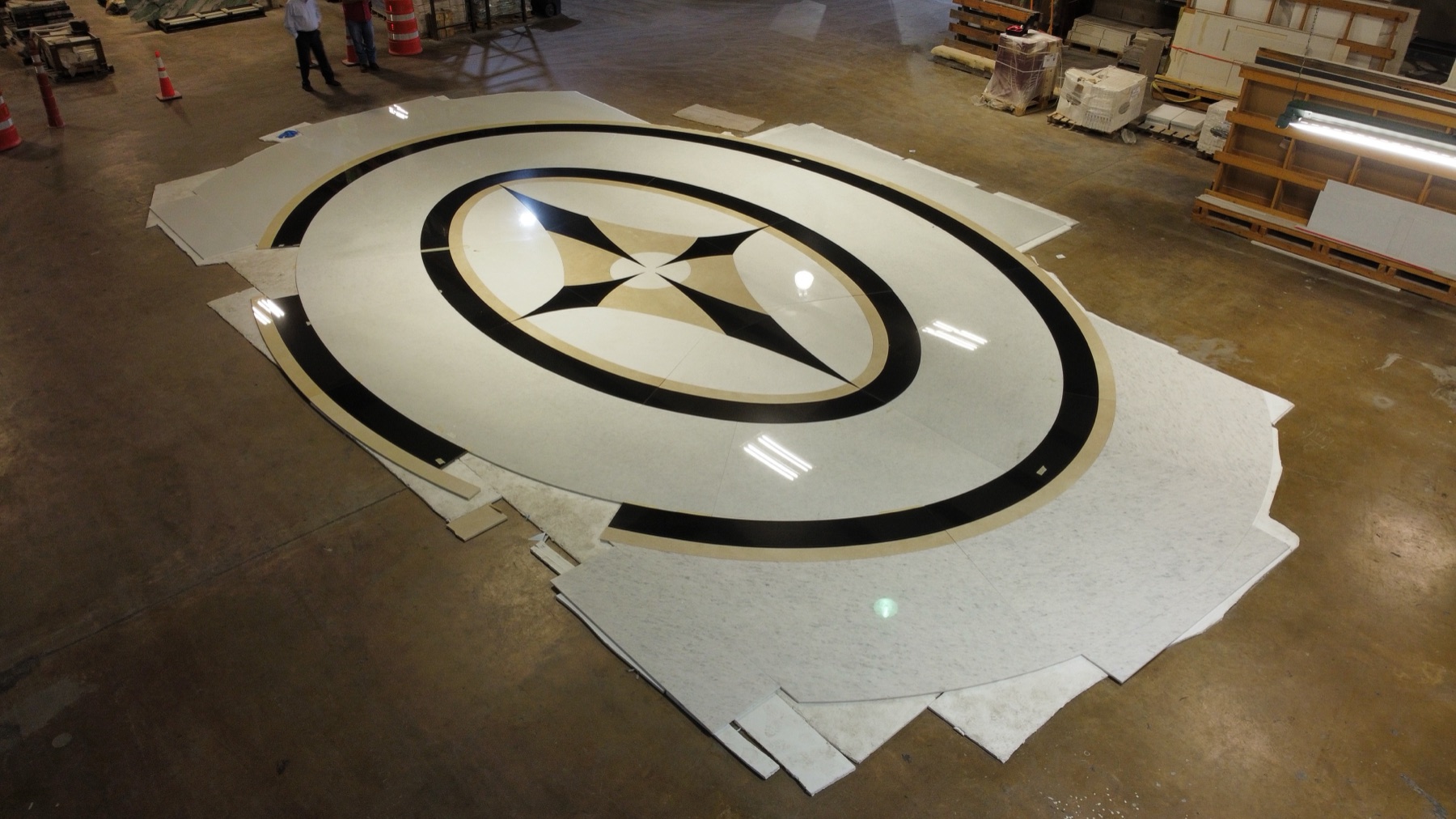
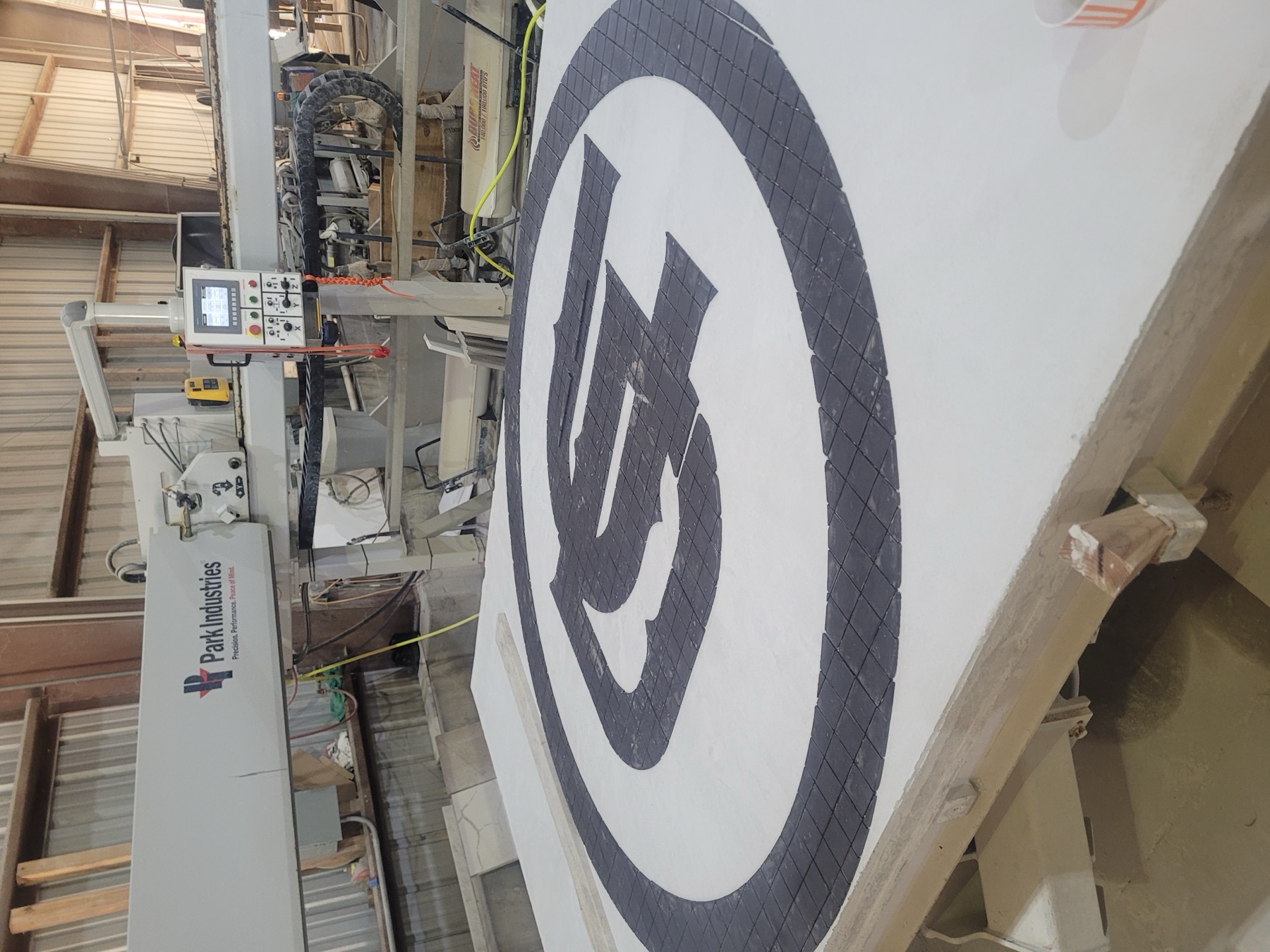
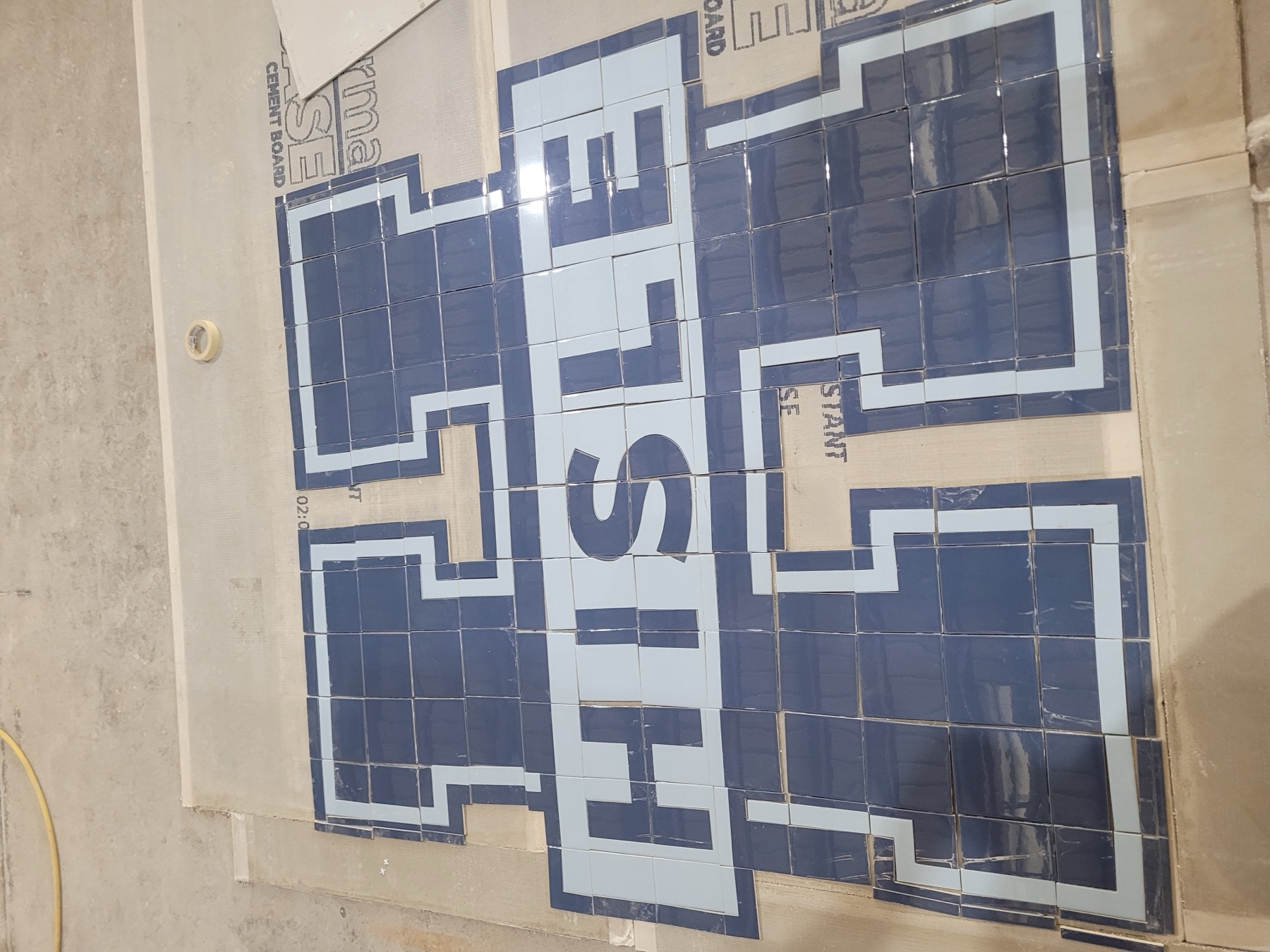
Computer-controlled waterjets cut complex profiles, radiused edges, inlays, and tight-tolerance details directly from the nested digital layout — no template re-cutting, no guesswork on the floor. Because the cut path comes straight from the approved SlabSmith layout, there's no hand-transferred template standing between the design and the blade — the geometry that was nested is the geometry that gets cut, down to radiused corners, sink and cooktop cutouts, decorative inlay lines, and curved edge profiles a manual saw table can't produce at all.

Bridge-saw and waterjet capability combined in a single machine path — straight cuts run fast on the saw side, complex geometry hands off to the jet, all from the same programmed layout. Routing straight rips to the saw blade and reserving the jet for curves, cutouts, and detail work keeps standard parts moving without tying up waterjet time on cuts that don't need it — both paths pull from the same nested program, so a part never has to be re-measured or re-marked as it moves between them.
Every slab is photographed and mapped digitally, then your parts are nested against its actual veining, color, and yield — the layout you sign off on before the CNC floor ever cuts. The same software can gang-nest parts from more than one job against a single slab's leftover space, so offcut that a by-eye layout would send to the scrap bin often still ends up as billable stone.
Three steps, in order, are what turn digital nesting into fewer square feet billed on your invoice.
Before any part is nested, the slab itself is scanned — its true outline, veining pattern, and any natural fissures or color shifts mapped in as an exact digital twin. Nothing is nested against a hypothetical clean rectangle; every layout runs against the slab that's actually on the rack.
Every part on the job — countertop sections, returns, backsplash, vanity tops, cutouts — is modeled at true size and tested in multiple rotations and positions against the slab image, hunting for the arrangement that uses the most stone while still respecting the seam placement, bookmatch pairing, and grain direction the job calls for.
The approved layout exports straight to the CNC waterjet and Sawjet controllers as a cut path — not a paper template someone re-measures on the floor. What was nested on screen is what leaves the shop, so the yield the software calculated is the yield you actually get.
Our CNC waterjet and Sawjet floor run granite, quartz, porcelain, marble, limestone, and solid surface across the slab thicknesses used in commercial and residential fabrication — typically 2cm and 3cm slab stock, plus heavier dimensional stone for hardscape, signage, and structural work. If you've got an unusual thickness or a material you're not sure about, raise it on a Facility Walk and we'll tell you straight whether it's a fit before you quote the job.
Tight enough that radiused edges, inlay lines, and cutouts land where they were nested, without a fabricator hand-fitting a part on-site to make it work. The waterjet cuts to the digital layout, not to a line someone re-marks by hand on the floor, so the part that leaves our shop matches the part you approved in SlabSmith.
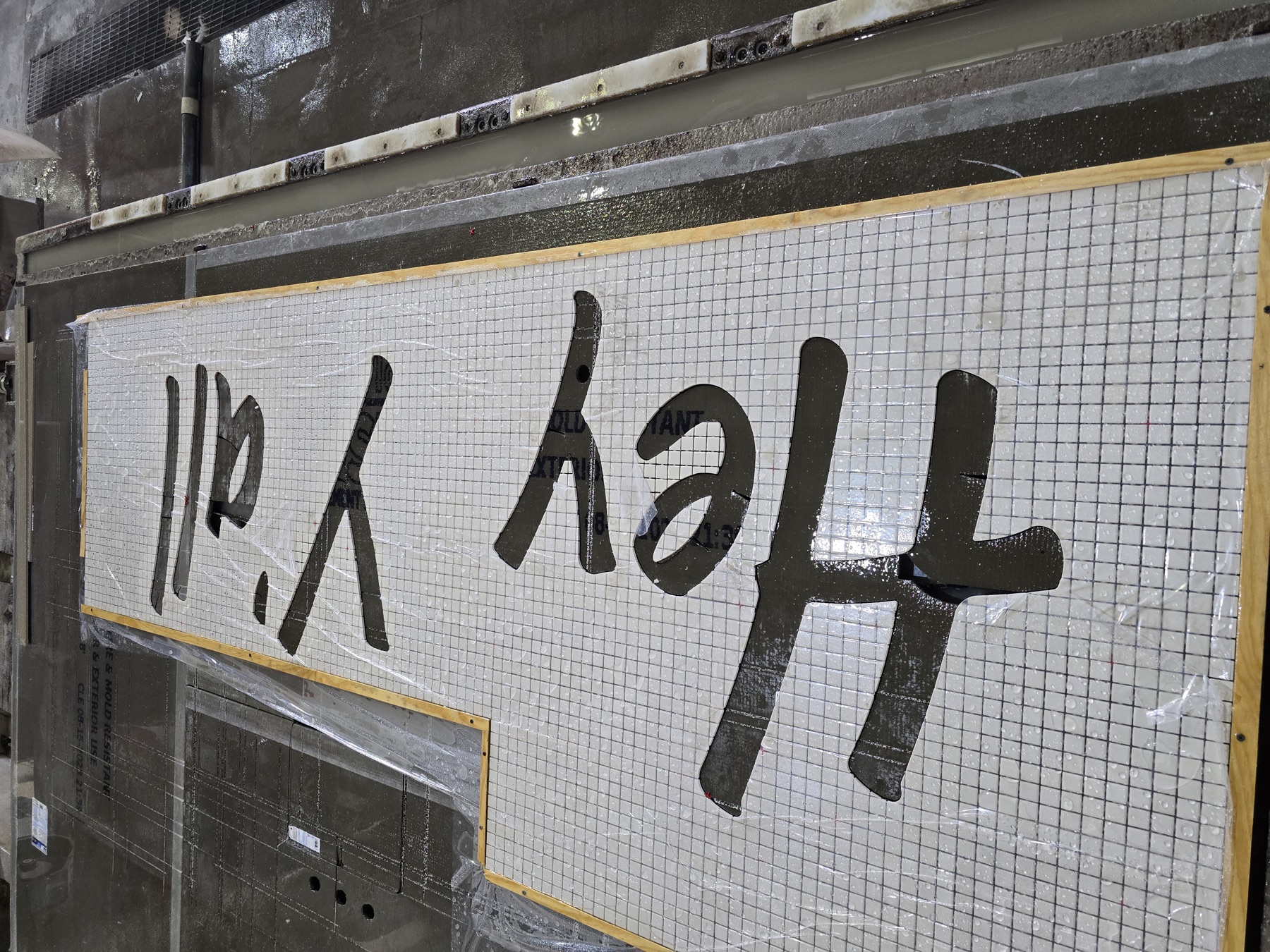
Custom shapes are most of what the waterjet is for. Straight rip cuts run faster on the Sawjet side; the waterjet earns its keep on radiused corners, curved edges, decorative inlay work, medallions, custom signage lettering, and cutouts a saw blade physically can't produce. If it can be modeled in the nesting software, it can be cut.
Yes. We regularly cut waterjet work — signage, inlay pieces, custom shapes, one-off parts — for shops and trade partners who handle their own fabrication and installation and just need the cutting done. Turnaround on waterjet-only work is typically faster than a full countertop job, since it skips templating, edge finishing, and install scheduling. Bring us the scope and we'll give you a real timeline.
Once we have your part dimensions, SlabSmith nests them against the actual slab stock we're pricing from, so the material estimate in your quote reflects real yield on real stone, not a rough square-footage guess. That's also where the ~30% comes from — the quote is built off what the software can actually fit on the slab, not padded for waste the way a by-eye layout has to be.
Yes. If you've already got dimensions, a CAD file, or a template from your own shop, send it over and we'll bring it into SlabSmith to nest against our slab stock rather than starting from scratch. It shortens the quote-to-cut timeline and gives you a chance to sign off on the layout before anything is cut.