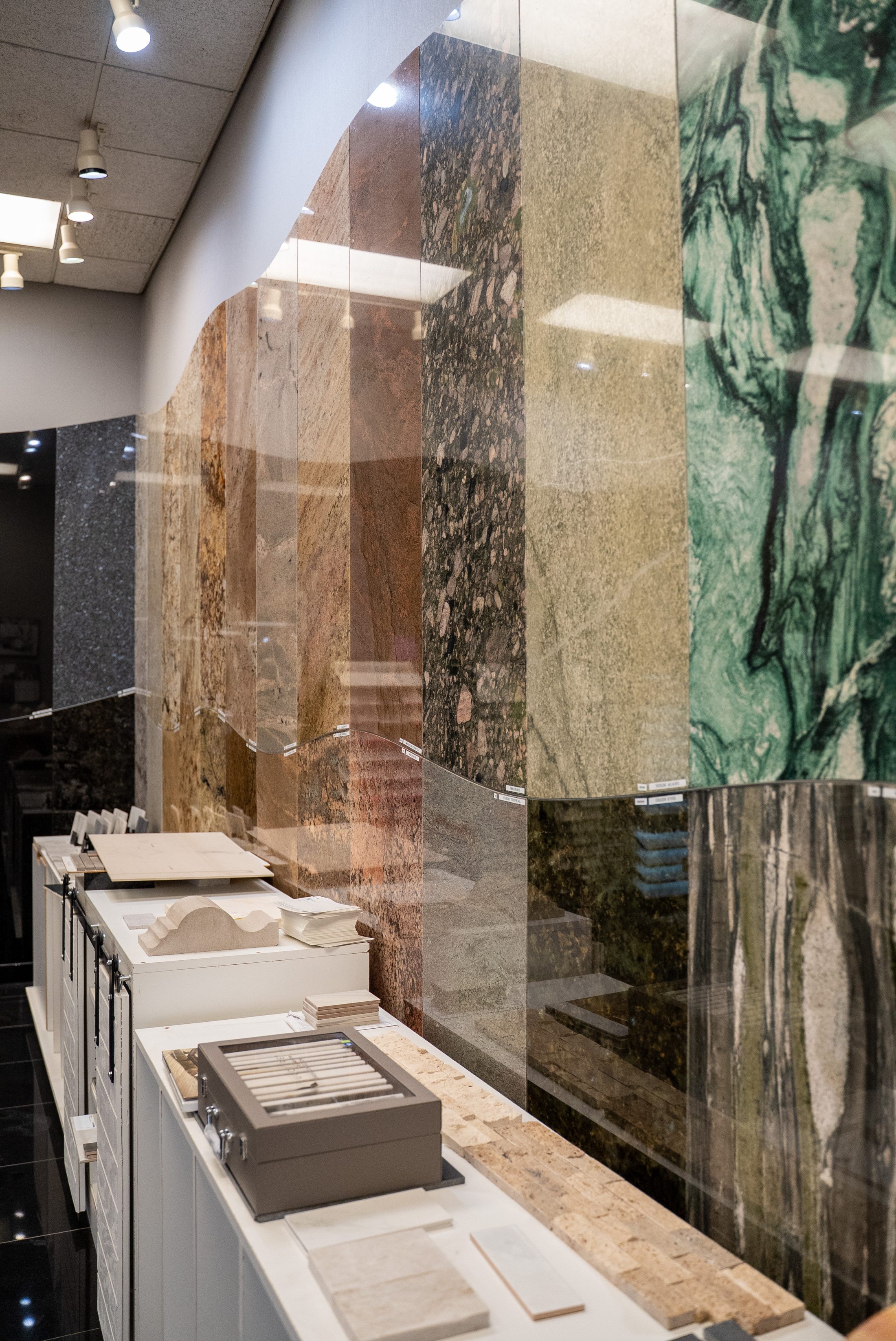
Houston builders and designers come to us for marble because no two slabs read the same — and because getting the veining, the seams, and the finish right takes a shop that fabricates it every week, not once a quarter.
Marble is metamorphosed limestone, and that geologic history is exactly what makes it desirable: mineral impurities recrystallize into the sweeping, irregular veining that no engineered material has ever fully replicated. Two slabs cut from the same block still read differently once they're polished and set in light — which is why we don't sell marble off a sample chip. Every commercial or residential job that specs marble through us gets to see and approve the actual slab, or the book-matched pair, before a single cut is made.
Book-matching is where marble fabrication separates a real stone shop from a countertop installer. Splitting a slab and opening it like a book so the veining mirrors across a seam — on a waterfall island edge, a shower wall, or a feature wall behind a reception desk — takes precise saw work and a seam that disappears rather than fights the pattern. That's templating and cutting work we do in-house, at our 52,080 sq ft Missouri City shop, not farmed out to a second vendor.
The honest trade-off: marble is softer and more porous than granite or engineered quartz. At roughly a 3 to 4 on the Mohs hardness scale — well below granite's 6 to 7 — it scratches and etches more easily, and acidic contact from citrus, wine, or common cleaning products can dull a polished finish if it sits too long. That's not a reason to avoid it; it's a reason to spec it where it belongs and seal it properly. We recommend a penetrating sealer on install and a maintenance schedule based on actual use — a lightly-touched feature wall or a formal vanity needs far less attention than a kitchen island. We walk every client through that conversation before, not after, the stone ships.
That's also why marble shows up most often on high-end vanities, primary bathroom surrounds, fireplace facings, and feature walls — applications where the veining is the point and the surface isn't absorbing daily acidic abuse. For kitchen counters and other heavy-use surfaces, we'll often steer clients toward granite or quartz and reserve the marble for the accent that gets noticed. Whichever way a project lands, it's cut, edged, and finished on the same floor, by the same crews, whether the job is a single vanity or a full commercial lobby package.
Vanities and primary bathrooms. This is marble's strongest use case in Houston homes — a single continuous slab or a book-matched pair set behind the sinks, framed by a waterfall edge or a simple eased edge that lets the stone do the talking. We template every vanity on site so plumbing cutouts, faucet holes, and backsplash returns line up exactly, then cut and finish the piece at our Missouri City shop before it ever touches the bathroom.
Feature walls and fireplace facings. A floor-to-ceiling marble wall behind a freestanding tub, a fireplace surround, or a great-room accent wall works because the veining reads as one continuous pattern across a large plane — something a printed or engineered material can't fake up close. These jobs live and die on slab selection, which is why we walk the client through the actual slab (or the matched set) before cutting, not a sample chip.
Flooring — selectively. Marble flooring shows up in formal entries, powder rooms, and low-traffic residential spaces where the look matters more than daily wear. We typically spec a honed rather than polished finish here, since a honed surface hides foot traffic and fine scratching far better than a high-gloss polish, and we'll flag square footage and traffic pattern up front if a client is considering marble somewhere it isn't the right fit.
Commercial accents. Reception desks, lobby feature walls, and formal common areas in office and hospitality builds use marble the same way residential feature walls do — as a statement surface in a space that isn't seeing spills and knife work every hour of the day.
Every marble installation we do ships with a penetrating sealer applied at the shop or at install, and a plain-language maintenance sheet for the specific finish and location — a vanity top and a floor don't need the same care schedule, and we don't hand clients a generic one-pager and call it done. Sealer slows absorption; it doesn't make marble stain-proof or acid-proof, and we say that plainly rather than oversell it.
Honed vs. polished. A polished finish gives marble its classic glossy, reflective look and shows veining at its most dramatic — but it also shows etching (dull spots from acidic contact) more visibly, since the contrast between the shiny surface and a dulled etch mark is sharp. A honed (matte) finish is more forgiving on both counts: etching and light scratching blend into the surface instead of standing out, which is why we recommend honed for floors, high-use vanities, and any surface a client wants to worry about less. Polished stays the right call for feature walls, fireplace facings, and other vertical or low-contact surfaces where the shine is the whole point.
What marble is not ideal for. We'll say this directly rather than let a client find out after installation: marble is not the right choice for a primary kitchen island or prep counter, an outdoor kitchen or exterior application in Houston's climate, or any surface that regularly sees citrus, wine, vinegar-based dressings, or acidic cleaners without a mat or trivet. For those uses we steer clients toward granite, quartz, or porcelain and save the marble for where its look actually gets to shine without a maintenance fight.
Marble's whole appeal — no two slabs read the same — is also its biggest fabrication risk. A vanity top cut from one slab and a shower surround cut from a different lot can clash badly if nobody's watching the veining and base color side by side. Our process is built around catching that before it becomes a change order.
For any job spanning more than one slab — a matched vanity pair, a kitchen island paired with a backsplash, a multi-unit commercial run — we pull candidate slabs from the same block or the same quarry lot whenever the order size allows it, and lay them out on our shop floor for a physical side-by-side approval before cutting. Clients see the actual seam location and veining flow, not a rendering, and sign off in writing. That's the same layout-approval discipline we use across every material we fabricate, not a marble-specific favor.
Where a project genuinely can't source matched slabs — a small job, a limited quarry run, a client who fell in love with one specific block — we say so up front and lay out the options: accept the natural variation, choose a more consistent alternative like quartz for the secondary surface, or wait for a better-matched lot to come through. We'd rather have that conversation before fabrication than after a mismatched seam ships to a job site.
Yes. Marble is naturally porous, so we apply a penetrating sealer at install and give every client a maintenance schedule matched to that specific surface — a lightly-touched feature wall needs re-sealing far less often than an active vanity top. Sealer reduces staining and slows absorption; it doesn't make the stone acid-proof, and we're upfront about that distinction.
It varies by slab — rare or heavily-veined marble blocks can run above premium granite, while more common marble can land close to mid-tier granite pricing. Quartz is engineered and typically more price-consistent since it isn't tied to a specific quarry block. We quote off the actual slab or material selected, not a generic per-square-foot number, so we can give you a firm price once you've picked a slab or price range.
It can hold up, but it's not our default recommendation for a primary kitchen island or prep counter — marble is softer than granite and etches with acidic contact (citrus, wine, vinegar) faster than either granite or quartz. Some clients choose it anyway for the look and accept the maintenance trade-off; others use marble on a secondary surface or backsplash and granite or quartz on the working counter. We'll walk through both paths honestly before you decide.
It depends on slab sourcing and order size — a job using slabs we can source and template quickly moves faster than one waiting on a specific rare block or a large book-matched set. We give a firm lead time once we know the scope and the material, and we build slab selection and client sign-off into that schedule rather than rushing past it.
Where the order size and quarry availability allow it, yes — we source from the same block or lot and lay slabs out side by side on our shop floor for approval before cutting. When matched slabs genuinely aren't available for a project, we tell you that up front and lay out the real options rather than force a mismatch through.
Used across: