News About Contact (281) 499-0561
Material Fabrication

Quartz, our default recommendation for busy spaces.

Engineered, not quarried — quartz is built for consistency and low upkeep. For commercial kitchens, bathrooms, and any surface that gets touched all day, it's usually the first material we bring up.

Quartz surfaces aren't cut whole from a quarry the way granite or limestone are — they're engineered, blending ground natural quartz with resins and pigments under heat and pressure into a slab. That manufacturing process is exactly what makes quartz useful: instead of hoping the next slab out of the lot matches the last one, a given color and pattern is formulated to repeat batch to batch. For a multi-unit commercial job, a hotel corridor, or a restaurant chain rolling the same look across several locations, that consistency solves a real scheduling and design problem that natural stone can't.

Quartz is also fully non-porous straight off the line. There's no sealing step, no resealing schedule, and no window where the surface is vulnerable to a spill it hasn't had time to absorb. That's why it's our default recommendation for commercial kitchens, break rooms, and multi-use bathrooms — high-traffic, high-turnover environments where somebody has to actually maintain the surface long after we've left the job, and "no maintenance plan required" is the whole point.

Durability follows the same logic. The engineered surface resists scratching and everyday impact on par with dense natural stone, without the periodic care that porous materials need to hold up over years of use. For ownership groups thinking in terms of total cost over the life of the building, quartz tends to be the lowest-friction counter or vanity surface we install — less follow-up, fewer callbacks, fewer surprises at turnover.

We fabricate quartz on the same floor, with the same templating and waterjet capability, as every natural stone that comes through our 52,080 sq ft Missouri City shop. It shows up across commercial kitchens and restrooms, luxury residential kitchens where a family wants granite's durability without a sealing routine, and as the standard spec on our Kitchen & Bath work.
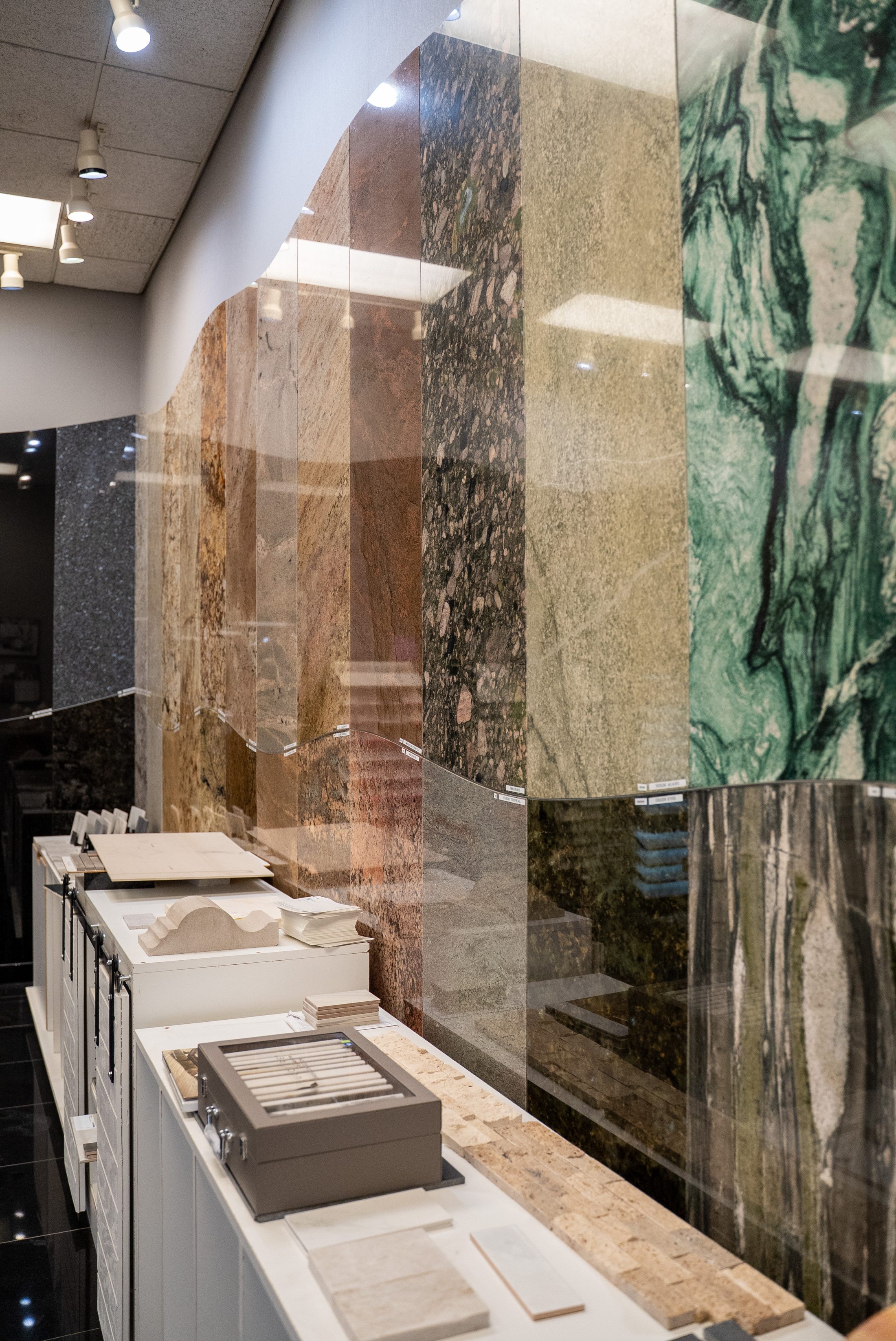
Engineered quartz and natural stone slabs at Cangelosi Company
Where It's Used

The default for spaces that don't slow down.

Commercial Kitchens

Restaurant, hotel, and institutional kitchens run counters through years of prep work, hot pans, spills, and constant cleaning chemicals with almost no downtime for maintenance. Quartz is usually the first material we bring up for that environment because it doesn't ask the operator to do anything extra to protect it — no sealing schedule to track, no etching from acidic foods, and a surface that looks the same on day 1,000 as it did on day one, assuming reasonable care.

Commercial Bathrooms

Multi-use restrooms in office buildings, restaurants, hotels, and medical or retail space see heavy daily traffic and get cleaned aggressively, often multiple times a day. Quartz vanities and countertops hold up to that cleaning cycle without the wear a porous natural stone would show over the same stretch of use, which is why it's become the standard spec on our Kitchen & Bath work for commercial restrooms and multi-family unit bathrooms alike.

Living With Quartz

Minimal upkeep, and slabs that match when it matters.

Care & Maintenance

Quartz is non-porous straight off the line, so day-to-day care is soap, water, and a normal cleaning routine — no sealing at install, no re-sealing schedule, and no window where an unsealed spot is vulnerable to a stain. Compare that to a natural stone like granite or marble, which needs periodic sealing to stay stain-resistant, or limestone, which needs both sealing and a lower-traffic application to hold up at all. For a facilities team maintaining dozens of units or a kitchen that can't pause for upkeep, that difference is the whole argument for quartz.

Batch Consistency for Large Orders

Natural stone is quarried, which means every slab in a lot carries some variation in veining, tone, and pattern — expected and often desirable for a one-off luxury kitchen, but a real problem for a 40-unit apartment build or a restaurant group rolling out the same look across five locations. Because quartz is engineered, a given color and pattern is formulated to repeat slab to slab and batch to batch, so what you approve on a sample matches what shows up on the truck, whether we're fabricating four countertops or four hundred. That predictability is what makes it the material of choice for multi-family, hospitality, and multi-location commercial orders where consistency across units matters as much as the material itself.

Common Questions

Quartz fabrication, answered.

Quartz or granite for a commercial kitchen?

Both are dense, durable surfaces that hold up in a working kitchen, but quartz is non-porous with no sealing required, while granite needs periodic resealing to stay stain-resistant. For a commercial kitchen where nobody has time to track a sealing schedule, we typically point clients to quartz; for a luxury residential kitchen where the client wants granite's natural veining and doesn't mind the upkeep, granite is still a great choice. We'll walk through the tradeoff for your specific job.

Does quartz need to be sealed?

No. Quartz is fully non-porous as manufactured, so there's no sealing at install and no resealing schedule to maintain — that's one of the main reasons it's the default recommendation for busy commercial kitchens and bathrooms.

How much heat can quartz handle?

Quartz resists everyday heat well, but the resin binder in an engineered slab can scorch or discolor under a very hot pan or dish set directly on the surface — something natural stone is less prone to. We recommend trivets or pads under cookware straight off the stove, the same standard advice any quartz fabricator gives, and it's a minor tradeoff against the material's near-zero maintenance otherwise.

Will the color and pattern stay consistent across a large order?

Yes — that's one of quartz's core advantages over natural stone. Because it's engineered rather than quarried, a given color and pattern is formulated to repeat batch to batch, so a 30-unit apartment job or a multi-location restaurant rollout gets matching slabs across every unit instead of the lot-to-lot variation you'd see with granite or marble.

What's the typical lead time on a quartz order?

It depends on scope and the specific color/pattern selected. Once templates are finalized and material is confirmed, most commercial quartz orders move through fabrication in a matter of weeks — often faster than a comparable natural stone order since we're not waiting on lot-specific slab selection. We'll give you a firm timeline once we see the spec, especially for large multi-unit orders where we're sequencing production across many countertops at once.

Used Across

Where quartz shows up in our work.

Same material, same shop — different applications depending on the project.

Ready When You Are

Send us the spec — we'll quote the stone.