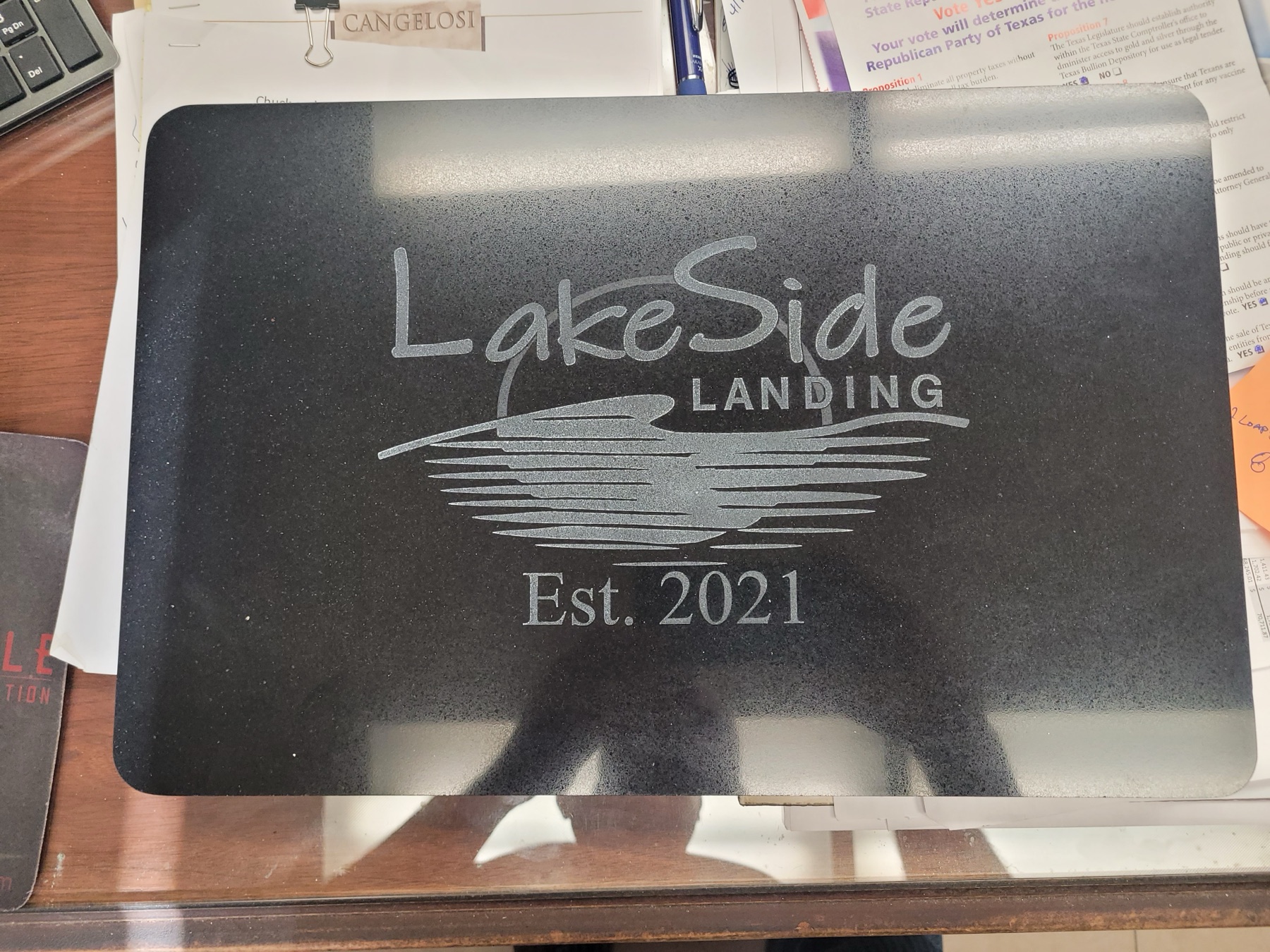
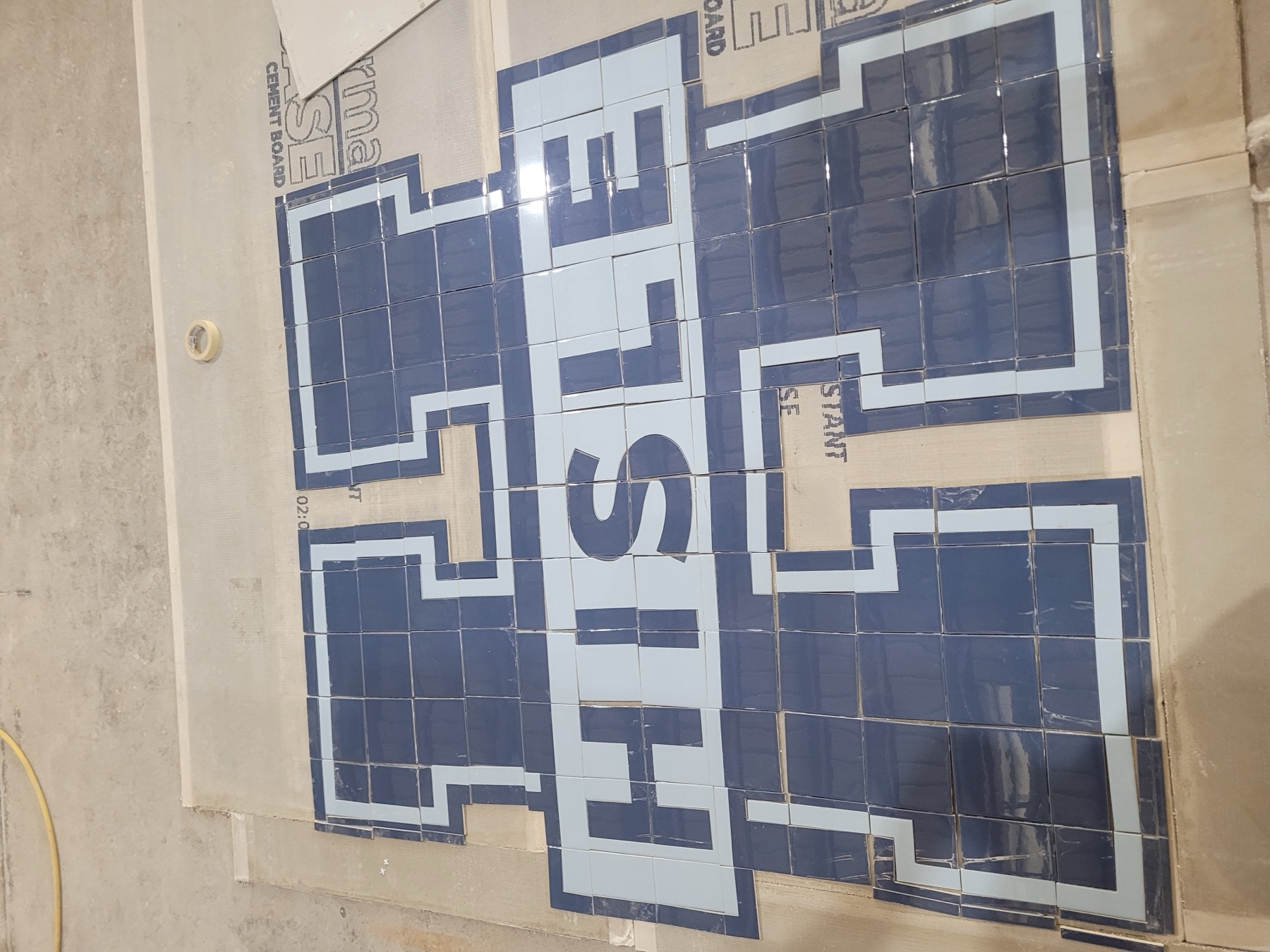
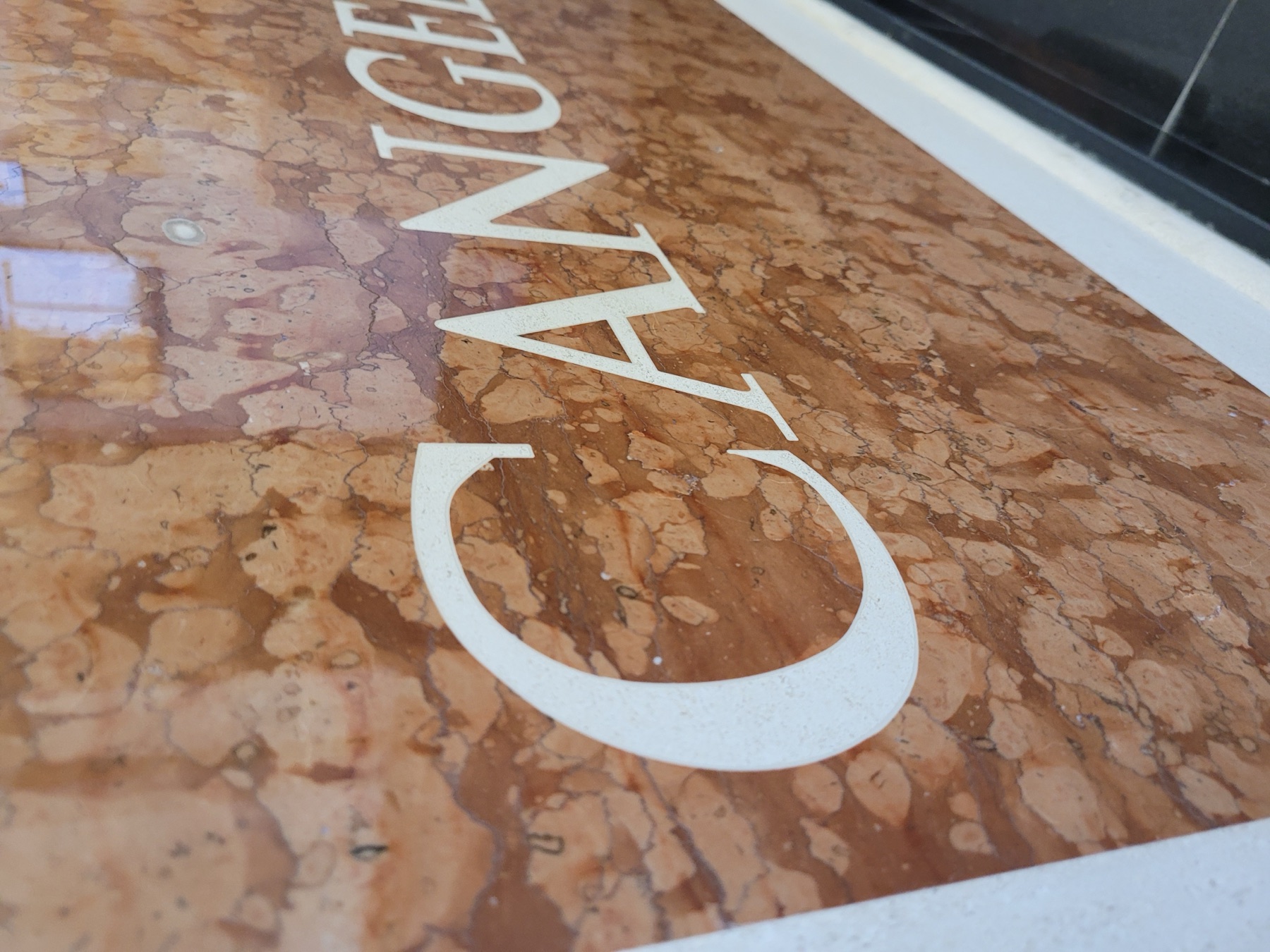
Developments, campuses, and commercial properties need signage that reads as permanent architecture, not an add-on. Sandblasting or waterjet cut lettering, logos, and inlay work directly into stone with a precision no router or hand chisel can match.
Monument signs live outside, at the front of a property, under direct scrutiny from every car that turns in. There's no hiding a rough edge or an inconsistent letterform at that scale — the sign is often the first physical impression a visitor forms of the whole development. That's why we treat custom signage as a precision-cutting job first and a masonry job second: the lettering geometry gets modeled and nested before a single slab hits the table, or plotted to your exact font for sandblasting.
Our waterjet handles the part that used to require a stonemason with a chisel and a steady hand for days at a time. A 5-axis abrasive waterjet head follows the exact vector path of a logo, monogram, or typeface — serifs, tight radii, and thin strokes included — and holds that path consistently whether we're cutting one sign or fifty for a multi-phase development. Raised letterforms, recessed (sandblasted-look) lettering, or true inlay — where a contrasting stone or metal fills a cut channel flush with the surrounding face — are all straightforward with this method, and all come out identical piece to piece.
Material choice depends on where the sign sits and what it needs to survive. Granite holds crisp edges outdoors for decades with minimal maintenance and is our default for monument entry signs. Limestone gives a softer, more traditional look for HOA and estate entries where a matte, quarried texture fits the architecture better than polished stone. For lit signage or backlit house-number panels, we can spec thinner cross-sections cut to the same tolerance. Whatever the substrate, layout is proofed and approved before cutting — no surprises on install day, and no re-cuts.
We fabricate and finish signage entirely in-house at our 52,080 sq ft Missouri City shop, then coordinate install with your GC or landscape contractor so the sign lands on schedule with the rest of the site work. If your project also calls for entry walls, address monuments, or hardscape elements around the sign, we handle that under the same job — see masonry for the surrounding stonework.
Most of what we cut falls into three categories: entry monuments at a development's main drive, building-identification signage — address numerals, tenant panels, wayfinding markers — mounted on or built into a facade, and dedication or memorial plaques for schools, churches, and public buildings where the lettering needs to read as permanent, not applied. Each has different scale and mounting requirements. An entry monument is a freestanding structural piece where we coordinate the base and footing with your civil or landscape drawings; a building-ID panel is typically anchor-mounted flush to an existing facade; a dedication plaque is usually a thinner panel set into a wall or pedestal that already exists. Waterjet or sandblasting ensure we can provide whatever desired finish your signage needs.
Stone signage lives outside in Houston's full range of weather — sun, humidity, freeze-thaw swings, and salt air closer to the coast — for decades, not years. Granite's density is what makes it the default for monument work: it doesn't fade, chalk, or lose edge definition under UV exposure the way painted or resin-cast signage does, and it doesn't absorb enough moisture to spall in a hard freeze. Limestone weathers more visibly over time — part of why it reads as "traditional" rather than "new" — and we seal it appropriately for an outdoor application. Porcelain is worth a look for large-format panel signage where an ultra-low-porosity face matters more than a natural quarried texture; see our porcelain page for where it fits. For colored inlay work, we spec fill materials rated for UV stability so a painted or resin-filled letter doesn't chalk out or discolor faster than the stone around it.
This work is powered by our Waterjet capability — see the full technical story behind the cut.
Granite is our default recommendation for anything freestanding at grade — it holds a polished or flamed edge through decades of UV exposure and Houston humidity without fading or chalking. Porcelain is a strong option for large-format panel signage and building-ID cladding where a consistent, ultra-low-porosity face matters more than a natural quarried texture. See our granite and porcelain pages for the full material comparison.
A 5-axis abrasive waterjet cuts from a vector file, so it follows the exact geometry of a typeface or logo — including serifs and tight radii a router bit can't clear — and repeats that path identically across every sign in an order. It's the same capability behind our broader waterjet work; signage is simply one of the more visible applications of it.
Once artwork and material are approved, most single monument or building-ID signs run a few weeks from cutting to ready-for-install; multi-sign orders for a phased development take longer depending on quantity. We give a firm date once we have final artwork and a material selection in hand — vague concept sketches slow that estimate down.
Our waterjet table and slab handling cover everything from a small dedication plaque to a multi-panel monument sign several feet across; anything larger than a single slab gets seamed and bookmatched so the joint reads as intentional rather than as a limitation. Extremely tall freestanding monuments may need an engineered base or footing beyond what we fabricate, in which case we coordinate directly with your GC's structural engineer on that interface.
The biggest cost factors are slab size and material grade, the complexity of the lettering and inlay work, and whether the sign is a single piece or a multi-phase order sharing setup and programming across several identical signs. A simple single-color engraved monument costs meaningfully less than a raised-letter, multi-material inlay piece of the same size — we'll break down where your budget is going once we see the artwork.